Last updated: November 2026. Transparency note: We run Quran Academy (equranacademy.org), where certified Al-Azhar male and female scholars teach 1-on-1 online Quran classes to children across the US, UK, Canada, and Australia. Every checkpoint below applies to us just as strictly as it applies to any other academy you evaluate.
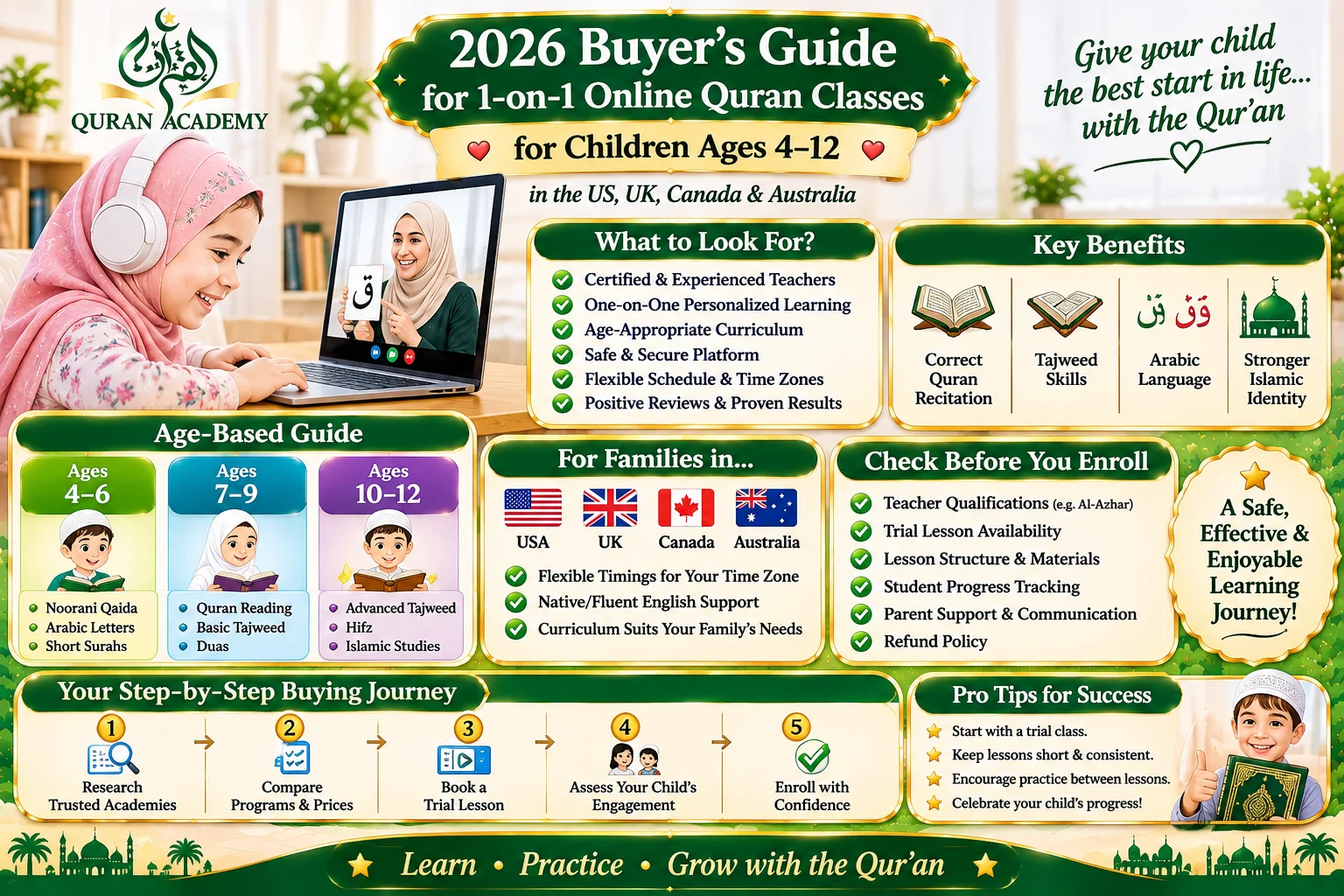
- The best online Quran classes for kids combine four essentials: 1-on-1 live instruction, an Ijazah-certified teacher who speaks clear English, a structured Noorani Qaida-to-Mushaf syllabus, and transparent monthly pricing.
- Avoid academies that hide teacher backgrounds, lock you into 6-month contracts, or place young beginners into crowded group Zoom rooms.
- Always score a live 30-minute free trial using the 7-point checklist below—watch your child's body language during the first 10 minutes more closely than the sales pitch.
- At Quran Academy, every kids' track runs 1-on-1 on Zoom with vetted Al-Azhar tutors at a flat $8/hour ($4 per 30-minute class, plans from $32/month) and a 30-day money-back guarantee.
Search for the best online Quran classes for kids and you will find dozens of websites that look almost identical. Every homepage promises "expert teachers," "affordable plans," and "fun interactive classes." Yet once you pay for the first month, the actual experience varies wildly—from warm, structured Al-Azhar scholars who make your child look forward to class, to distracted tutors reading off a blurry PDF while your child loses focus.
Choosing the wrong program wastes more than tuition money. A bad first experience can make a 6-year-old dread Quran time for years. On the other hand, the right 1-on-1 teacher builds fluent reading, accurate Tajweed, and a genuine love for the Book of Allah right from your kitchen table.
This 7-point parent checklist gives you concrete, observable standards to test any online Quran academy before you spend a dollar.
What Separates the Best Online Quran Classes for Kids from Average Ones?
The best online Quran classes for kids deliver 100% live 1-on-1 instruction with Ijazah-certified teachers fluent in English, age-specific curricula, transparent parent portals, and month-to-month billing. Average platforms rely on unvetted freelancers, large group Zoom calls, rigid contracts, and zero progress tracking.
Use the comparison matrix below to see how a top-tier kids' academy stacks up against typical low-cost marketplaces and group Zoom programs in 2026.
| Parent Checklist Criterion | Top-Tier 1-on-1 Academy (Quran Academy) | Freelance Tutor Marketplaces | Online Group Zoom Classes |
|---|---|---|---|
| 1. Teacher Credentials | ✅ Vetted Al-Azhar graduates with verified Ijazah | ⚠️ Self-reported profiles; parents must vet alone | ⚠️ Varies widely by instructor |
| 2. Child Engagement & English | ✅ Fluent English + interactive whiteboard & rewards | ⚠️ Hit-or-miss English accent & child pedagogy | ❌ Kids wait muted while others read |
| 3. Structured Curriculum | ✅ Step-by-step Noorani Qaida, Tajweed, Hifz & Islamic Studies | ❌ Often improvised lesson by lesson | ⚠️ Fixed group pace (too fast or too slow) |
| 4. Child Safety & Parent Portal | ✅ Vetted male/female tutors + attendance & homework portal | ❌ Private links with zero academy oversight | ⚠️ Shared camera/chat with other kids |
| 5. ADHD / Shy Child Adaptability | ✅ Custom 15–30 min pacing, sensory-friendly routine | ⚠️ Depends entirely on luck | ❌ High distraction & social anxiety |
| 6. Pricing & Refund Protection | ✅ Flat $8/hr ($32/mo+), no contract, 30-day guarantee | ⚠️ $10–$30/hr + platform commission fees | ⚠️ $35–$80/mo for minimal individual reading |
Now let us walk through all seven checkpoints in detail so you know exactly what to ask, what to look for, and which red flags mean you should walk away.
Point 1: Verified Al-Azhar Credentials and Authentic Ijazah
Always verify that your child's teacher holds formal Quranic credentials—ideally a degree from Al-Azhar University or an authenticated Ijazah (unbroken chain of narration) in Hafs 'an 'Asim. Being a native Arabic speaker does not automatically qualify someone to teach Tajweed or Noorani Qaida to children.
Many parents assume that any fluent Arab speaker can teach a 7-year-old how to read the Quran. In practice, everyday spoken Arabic (Egyptian, Levantine, or Gulf dialects) drops or softens several Classical Quranic letters. Without formal Tajweed training, a well-meaning tutor can accidentally teach your child to pronounce Dhaad (ض) like a heavy "D" or skip Ghunnah (nasalization) altogether.
Fixing ingrained pronunciation errors later takes twice as long as learning them right the first time. Before enrolling, ask the academy three direct questions:
- Where did the teacher study? Look for recognized institutions like Al-Azhar University or certified Quranic institutes.
- Do they hold an Ijazah? An Ijazah confirms that a qualified scholar listened to the teacher recite the entire Quran from memory with exact Tajweed rules.
- Can I see teacher profiles before booking? Transparent academies publish real bios and credentials—like our verified Al-Azhar male and female tutors directory—rather than hiding behind anonymous "assigned teachers."
Point 2: Fluent English and Child-Friendly Teaching Style
For children growing up in the US, UK, Canada, or Australia, a Quran teacher must speak clear, natural English and use positive reinforcement instead of strict lecturing. When a child understands why a rule works and feels praised for small wins, motivation stays high without parental nagging.
Watch closely during the trial class for how the teacher handles a mistake. An old-school, impatient tutor sighs, interrupts abruptly, or repeats the same Arabic word louder when a child gets confused. A trained children's teacher smiles, breaks the sound down visually ("put the tip of your tongue right behind your top front teeth"), celebrates the first correct try, and moves forward calmly.
Look for these four green flags in child-friendly communication:
- Clear English explanations: The teacher explains Fathah, Kasrah, Dammah, and Tajweed rules using simple analogies a 6-year-old grasps immediately.
- Warmth and patience: The teacher greets your child by name, asks a quick friendly question at the start, and keeps the tone encouraging.
- Interactive screen sharing: The teacher uses a digital whiteboard, color-coded letters, and on-screen pointing rather than holding a paper book up to a webcam.
- Built-in motivation: Simple tools like digital stars, weekly streaks, or a printable Kids Quran Reward Chart turn daily practice into a habit children feel proud of.
Point 3: Structured, Age-Appropriate Curriculum (Ages 4–12)
The best online Quran classes for kids follow a written, milestone-based syllabus—not random Surah repetition. A strong program matches lesson length and content to your child's age, moving logically from Noorani Qaida phonics to fluent Mushaf reading, applied Tajweed, and structured Hifz.
A 5-year-old and an 11-year-old learn completely differently. If an academy puts both ages through the exact same 60-minute lecture format, the younger child will melt down and the older child will get bored. Below is the age-by-age progression we recommend parents look for in 2026:
| Age Group | Ideal Session Length | Core Curriculum Focus | Realistic 6-Month Milestone |
|---|---|---|---|
| Ages 4 – 6 (Early Readers) | 20 – 30 mins (2–3×/week) | Arabic alphabet recognition, basic vowels (Harakat), short Duas, Surah Al-Fatihah & 3 Quls | Recognizes all 28 letters & joins 2–3 letter words |
| Ages 7 – 9 (Foundational) | 30 mins (3×/week) | Full Noorani Qaida mastery, reading Juz Amma directly from the Mushaf, basic Tajweed rules | Reads short Surahs independently with accurate Makharij |
| Ages 10 – 12 (Fluency & Hifz) | 30 – 45 mins (3–5×/week) | Fluent Mushaf recitation, applied Tajweed (Noon/Meem Sakinah, Madd), structured Hifz & Islamic Studies | Memorizes Juz Amma / Juz Tabarak with strong Sabaq-Sabqi-Manzil revision |
You can see how these tracks are organized by age and level on our dedicated online Quran classes for kids page.
Point 4: Strict Child Safety, Privacy, and Parent Visibility
A safe online Quran academy vets every instructor with formal identity checks, offers dedicated female teachers for daughters, never contacts children privately outside official channels, and gives parents a live portal to monitor attendance, homework, and saved whiteboards.
Child safety online is non-negotiable. Never enroll your child with an unverified stranger from a social media comment section who asks to message your child directly on WhatsApp or Discord. A professional academy maintains strict institutional boundaries:
Engaging Online Quran & Arabic Classes for Kids (Ages 4–12)
Interactive Noorani Qaida, short Surahs, and star reward charts with warm, bilingual Al-Azhar tutors — starting at $4/class.
- All scheduling and communication go through the parent: Teachers communicate homework and progress through the parent portal or parent-monitored channels—never via private DMs to minors.
- Option for certified female teachers: Parents of young children and daughters should be able to request a female Al-Azhar Ustadhah at no extra cost.
- Open-room household rule: Keep your child's tablet or laptop in a shared family space (living room or kitchen) so you can casually hear the tone and quality of every class.
- Transparent parent reviews: Check independent, verified parent testimonials from families in your region—such as our verified student and parent reviews—before committing.
Point 5: Adaptability for Shy, Distracted, or Neurodivergent Kids (ADHD & Autism)
A strong online Quran academy adjusts session length, visual cues, and pacing to fit your child's temperament instead of forcing every student into the same rigid 60-minute mold. Look for tutors trained to support shy readers, energetic toddlers, and neurodivergent children with ADHD or autism.
Many parents delay Quran classes because their 7-year-old cannot sit still for an hour or freezes up when asked to read aloud in front of other kids. In a physical classroom, those children get labeled "distracted" or "behind." In a well-run 1-on-1 online class, the teacher adapts the lesson around how your child actually learns.
Specifically, ask the academy how they handle these three common scenarios:
- Short attention spans and ADHD: Can the tutor split a 30-minute session into two 12-minute learning sprints separated by a 2-minute stretch or interactive whiteboard game? Families who need specialized support can explore our online Quran classes for kids with ADHD and autism.
- Shyness and perfectionism: Will the teacher allow a shy child to keep the camera angled on the Mushaf for the first couple of lessons while trust builds?
- Siblings at different levels: Can two siblings take back-to-back 30-minute private sessions with the same trusted tutor so each child gets undivided attention without sibling comparison?
Point 6: Transparent Pricing, Flexible Rescheduling, and No Long-Term Lock-In
Reputable online Quran academies publish flat hourly or monthly rates upfront, run month-to-month with zero registration fees, and allow easy rescheduling for school exams, illness, or travel. Avoid platforms that require a 6-month upfront payment or hide tuition behind a high-pressure sales call.
In 2026, most quality 1-on-1 online Quran classes for kids cost between $8 and $12 per hour ($32 to $80/month for two to five 30-minute classes per week). At Quran Academy, every kids' program uses a flat $8/hour rate ($4 per 30-minute private class) with plans starting at $32/month and a 30-day money-back guarantee.
Before you enter a payment method on any website, confirm these four billing policies in writing:
- Zero setup or book fees: Noorani Qaida PDFs, Tajweed charts, and digital homework sheets should be included in tuition.
- Fair makeup policy: Check how many hours of notice are needed to reschedule a missed class without losing credit.
- Free teacher switch: If your child does not click with the first tutor after two weeks, you should be able to switch teachers at no extra charge.
- Clear monthly breakdown: For a full side-by-side comparison of Western market rates, see our 2026 Online Quran Classes Pricing Guide.
Point 7: Measurable Progress Tracking and Consistent Homework
The best online Quran classes for kids give parents clear visibility into weekly progress through a student portal, written lesson notes, and short 5-minute daily practice tasks. Without a simple tracking loop, months can pass without parents knowing which Tajweed rules or Surahs their child has actually mastered.
Real fluency happens in the 5 to 10 minutes between live classes. A good teacher never dumps an hour of confusing homework on a tired third-grader. Instead, they assign one bite-sized target—such as reading three lines of Noorani Qaida aloud twice after Maghrib—and log it clearly in the portal so parents know exactly what to review.
If your weekdays are already packed with schoolwork and sports, look for academies that offer dedicated weekend online Quran classes (Saturday & Sunday) so your child stays consistent without weekday exhaustion.
The 30-Minute Free Trial Scorecard: How to Test Any Academy Live
Never judge an online Quran academy by its homepage alone. Book a free 30-minute trial class, sit quietly beside your child, and score the session across five observable signals. A great teacher earns at least 4 out of 5 green lights on day one.
| What to Watch During the Free Trial | Green Light (Enroll) | Red Flag (Keep Looking) |
|---|---|---|
| First 3 Minutes (Rapport) | Smiles, greets your child by name, puts them at ease | Jumps straight into drills with a stern tone |
| Audio & Visual Setup | Clear mic, quiet room, crisp screen-shared Mushaf/whiteboard | Background noise, laggy video, holding paper to camera |
| Error Correction | Patiently demonstrates tongue placement & praises effort | Interrupts harshly or ignores clear Makharij mistakes |
| Level Assessment | Gives you a clear starting point & 90-day goal at the end | No structured plan; only pushes for immediate payment |
| Your Child's Reaction After Class | Says "That was fun!" or feels proud of what they read | Looks relieved it is over or asks not to go back |
Put Quran Academy to the 7-Point Test for Free
Book a free 30-minute 1-on-1 evaluation class with a certified male or female Al-Azhar tutor. No credit card required, flat $8/hr tuition ($32/month plans), and a 30-day money-back guarantee.
Book Your Child's Free Trial →Frequently Asked Questions About Online Quran Classes for Kids
What is the best age to start online Quran classes for kids?
Most children are ready to start gentle 1-on-1 online Noorani Qaida classes between ages 4 and 5. At this stage, 20-to-30-minute sessions two or three times a week work best, with a parent sitting nearby for the first few lessons to help build focus.
How many days a week should a child take online Quran classes?
For beginners learning Noorani Qaida or Quran reading, three 30-minute classes per week ($48/month) hits the sweet spot between steady retention and school-week balance. Children on a dedicated Hifz (memorization) track progress fastest with five 30-minute sessions per week ($80/month).
Are online Quran classes safe for young children?
Yes, when you choose an established academy with vetted male and female teachers, keep the device in a shared family room, and ensure all scheduling and homework communication goes through the parent portal rather than private messages to the child.
Can I request a female Quran teacher for my daughter or young son?
Yes. Quran Academy has Ijazah-certified female Al-Azhar Ustadhahs who specialize in teaching young kids and daughters in clear, warm English at the exact same $8/hour rate.
What equipment does my child need for online Quran classes?
A laptop, tablet, or desktop computer with a stable internet connection and a basic pair of headphones is all you need. Headphones help your child hear exact Arabic letter pronunciation clearly without household background noise.
What if my child is already attending weekend mosque school?
Online 1-on-1 classes pair well with weekend school. Many families book two 30-minute online sessions per week ($32/month) to build actual reading fluency and Tajweed accuracy while keeping the local masjid for Muslim friendships and community events.
