
Last updated: November 2026 • Written by Ustadhah Yasmeen Gamal, Al-Azhar University Graduate & Early-Years Curriculum Lead at Quran Academy.
Quick Answer: Best Way to Teach Arabic Letters to Toddlers
The most effective way to teach Arabic letters to toddlers (ages 2.5 to 5) is through 5-to-10-minute tactile Montessori sensory games—such as salt-tray tracing, playdough letter shaping, and dot-matching puzzles—introducing only one letter family per week rather than drilling all 28 letters at once.
- Group by Shape Families: Teaching Baa, Taa, Thaa (ب ت ث) together helps toddlers spot dot patterns instantly instead of memorizing 28 random shapes.
- Touch Before Pencils: Preschool hands build muscle memory faster in sand, playdough, and foam magnets than on paper worksheets.
- Bridge to Live Recitation: Once your child turns 4, pair these home games with gentle online Quran for toddlers so a certified Al-Azhar Ustadhah locks in accurate pronunciation.
Hand a 3- or 4-year-old a black-and-white Arabic alphabet worksheet and a pencil, and you have about ninety seconds before they walk away. Toddlers are not wired for desk drills—they learn through their fingers, ears, and movement.
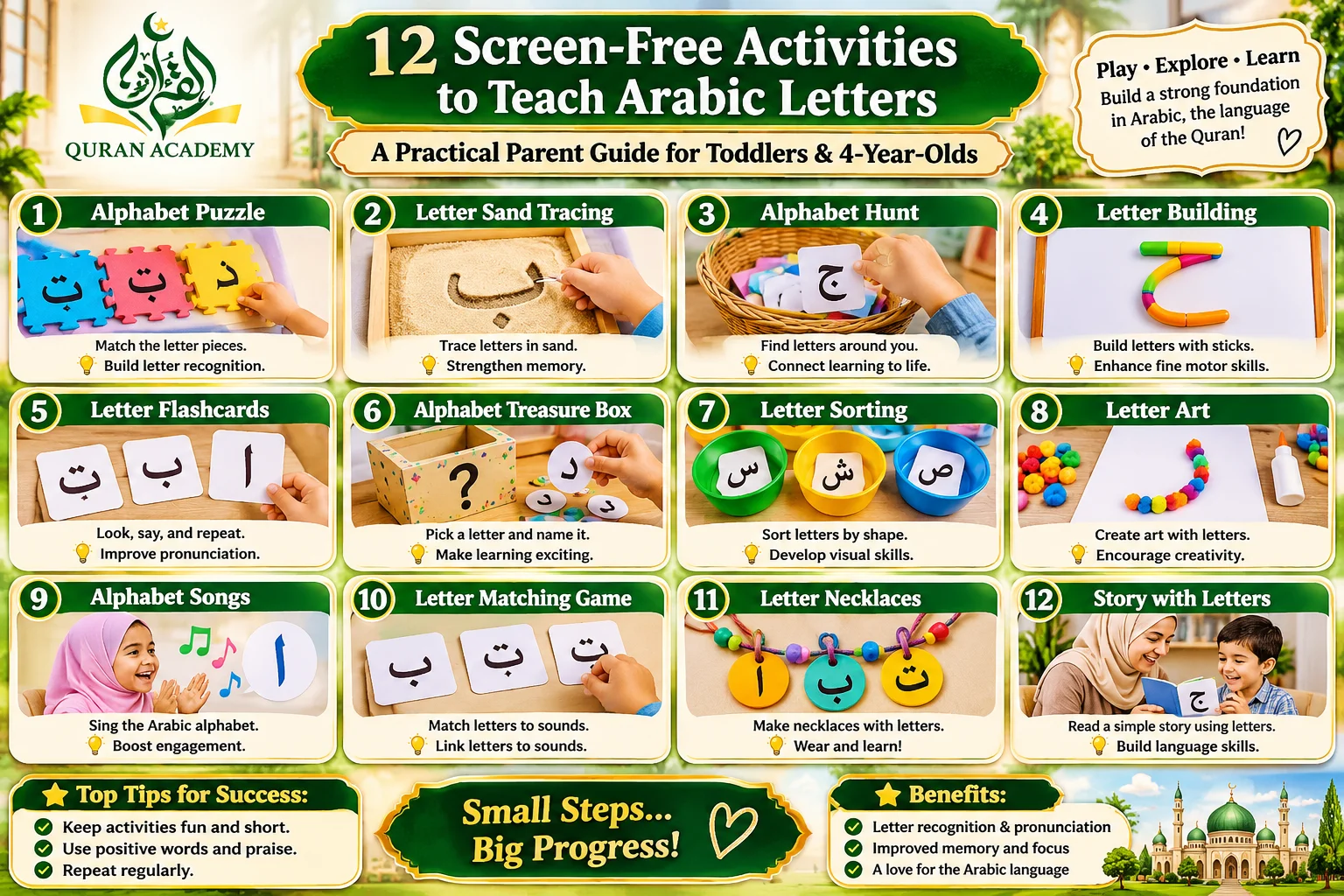
When you teach Arabic letters to toddlers through hands-on sensory play, something remarkable happens: letter recognition stops feeling like a chore and turns into the favorite part of their afternoon. Alongside our readiness pillar on the best age to start Quran lessons, this guide gives you 12 low-prep Montessori activities you can set up in under five minutes using items already in your kitchen.
Sensory Arabic Letter Activities by Age & Prep Time (Quick Matrix)
Different sensory games suit different developmental stages. Use the table below to pick the right screen-free activity based on your child's age, your available prep time, and the exact Arabic reading skill you want to build this week.
| Activity Category | Best Age | Prep Time | Core Arabic Skill Built |
|---|---|---|---|
| Salt / Semolina Tracing Tray | Ages 3 – 5 | 2 minutes | Right-to-left stroke direction & letter curves |
| Playdough Boat & Pom-Pom Dots | Ages 2.5 – 4.5 | 3 minutes | Mastering dot placement (Baa, Taa, Thaa) |
| Living Room Letter Hopscotch | Ages 3.5 – 6 | 5 minutes | Rapid auditory-to-visual sound recognition |
| Magnetic Fishing & Fridge Hunt | Ages 3 – 5.5 | 2 minutes | Sorting similar letter families (Jeem, Haa, Khaa) |
| 1-on-1 Whiteboard Flashcard Games | Ages 4 – 6 | 0 minutes (Teacher-led) | Exact Arabic Makharij & Noorani Qaida readiness |
4 Tactile Montessori Activities (Touch & Trace)
Montessori early-childhood educators teach letters through fingertips before pencils because tactile feedback wires letter shapes directly into long-term motor memory. Set up one of these four trays for just 5 minutes after snack time.
- 1. The Semolina or Salt Tracing Tray: Pour a thin layer of colored salt, fine sand, or semolina into a shallow baking tray. Place one large flashcard (like ب) above the tray and let your toddler trace the curve from right to left with their index finger, then poke one dot underneath. Shake the tray gently to "erase" and repeat.
- 2. Playdough "Boat" and Pom-Pom Dots: Roll one green playdough snake into a boat shape. Ask your child to place one pom-pom underneath ("Baa has one belly button!"), two pom-poms inside ("Taa has two eyes!"), and three pom-poms inside ("Thaa has three dots!"). This single game solves the #1 confusion in early Arabic reading.
- 3. DIY Sandpaper Arabic Letters: Cut letter shapes out of fine sandpaper or textured glitter foam and glue them onto sturdy index cards. Have your child close their eyes, feel the rough shape, and guess which letter is hiding under their fingers.
- 4. Shaving Cream or Water-Paint Mat: Spray a thin cloud of shaving cream on a washable tray (or use a wet paintbrush on dark construction paper) so your child can paint giant Arabic letters with zero mess anxiety.
4 High-Energy Movement Games for Active Toddlers
Active 3- and 4-year-olds remember Arabic letters twice as fast when their whole body is moving. These four zero-cost floor games burn afternoon energy while training your child's ear to match spoken Arabic sounds with visual letters.
Master Quranic Arabic Grammar & Vocabulary 1-on-1
Move beyond translations. Learn Nahw, Sarf, and high-frequency Quranic roots step-by-step with certified native Arab teachers — starting at $4/class.
- 5. Living Room Letter Hopscotch: Write 5 to 6 Arabic letters on printer paper and tape them securely to the carpet. Call out a letter sound ("Jump on Jeem!") and cheer as your toddler hops onto the matching sheet.
- 6. Flashlight Letter Hunt (Before Bedtime): Tape 4 big Arabic letter cards onto the bedroom wall, dim the lights, and hand your child a small flashlight. Ask them to shine the beam on the letter you call out—kids beg to play this every night.
- 7. Beanbag Toss Into Letter Bowls: Label three plastic bowls with one letter family (such as ج ح خ). Call out a sound and let your child toss a soft rolled-up sock or beanbag into the matching bowl.
- 8. Musical Arabic Freeze: Play a calm Arabic alphabet Nasheed (voice-only) while your child walks around a circle of letter cards. When you pause the audio, they freeze and tell you the name of the letter by their feet.
4 Everyday Kitchen & Fridge Games (Zero Extra Prep)
You do not need a homeschool room to teach Arabic letters. Turning everyday transitions—like cooking dinner or bath time—into 3-minute letter games builds effortless daily repetition without adding stress to your schedule.
- 9. Fridge Magnet "Letter of the Week": Keep only 3 to 4 magnetic Arabic letters on the fridge at child eye level (putting all 28 up at once is overwhelming). Ask your child to hand you Meem while you prepare breakfast.
- 10. Bath-Time Foam Letter Fishing: Float foam Arabic letters in the tub and give your toddler a small kitchen strainer to "fish" out the letter you name.
- 11. Snack-Time Letter Building: Use pretzel sticks, carrot strips, or Cheerios on a plate to build Alif, Daal, or Laam—and let your child eat the letter once they say its sound clearly.
- 12. Sticker & Star Chart Matching: Every time your child recognizes the week's letter family three days in a row, let them place a star on their printable Kids Quran Reward Chart.
When to Transition From Home Sensory Play to Live 1-on-1 Classes
Home sensory games build visual familiarity and love, but they cannot replace a native Al-Azhar ear for exact Arabic pronunciation (Makharij). Once your child reaches age 4 and recognizes 5 to 10 letters comfortably, pair home play with two 20-minute 1-on-1 classes per week.
If you are wondering how to balance Arabic letters with short Surah memorization once your child hits age 4 or 5, read our companion guide on whether a 4- or 5-year-old should learn Noorani Qaida or short Surahs first. In our dedicated online Quran for toddlers and ages 4–6 track, our female Al-Azhar Ustadhahs keep the exact same playful energy—using digital whiteboard games, flashcards, and bedtime stories so your child never loses their smile.
Ready for Playful 1-on-1 Arabic & Quran Classes?
Book a free 1-on-1 evaluation class with a warm Al-Azhar female Ustadhah. Our 20-minute interactive sessions for ages 4–6 start at just $4 per class ($32/month) with a 30-day money-back guarantee.
Frequently Asked Questions
1. What is the best order to teach Arabic letters to toddlers?
Teach them in visual shape families—starting with Alif (أ), then the boat family (ب ت ث), then the belly family (ج ح خ). Grouping by shape helps toddlers focus on dot placement rather than memorizing 28 unrelated symbols.
2. How many Arabic letters should a 3- or 4-year-old learn per week?
Introduce just 1 to 3 letters per week (one shape family) and review them through 5-minute sensory games. Slow, joyful mastery prevents letter confusion later in Noorani Qaida.
3. Are Arabic learning apps better than sensory games for toddlers?
Physical sensory games outperform apps for ages 2.5 to 4 because touching real shapes builds stronger memory without screen overstimulation. Save screens for live 1-on-1 interaction with a real Al-Azhar teacher once your child turns 4.
