
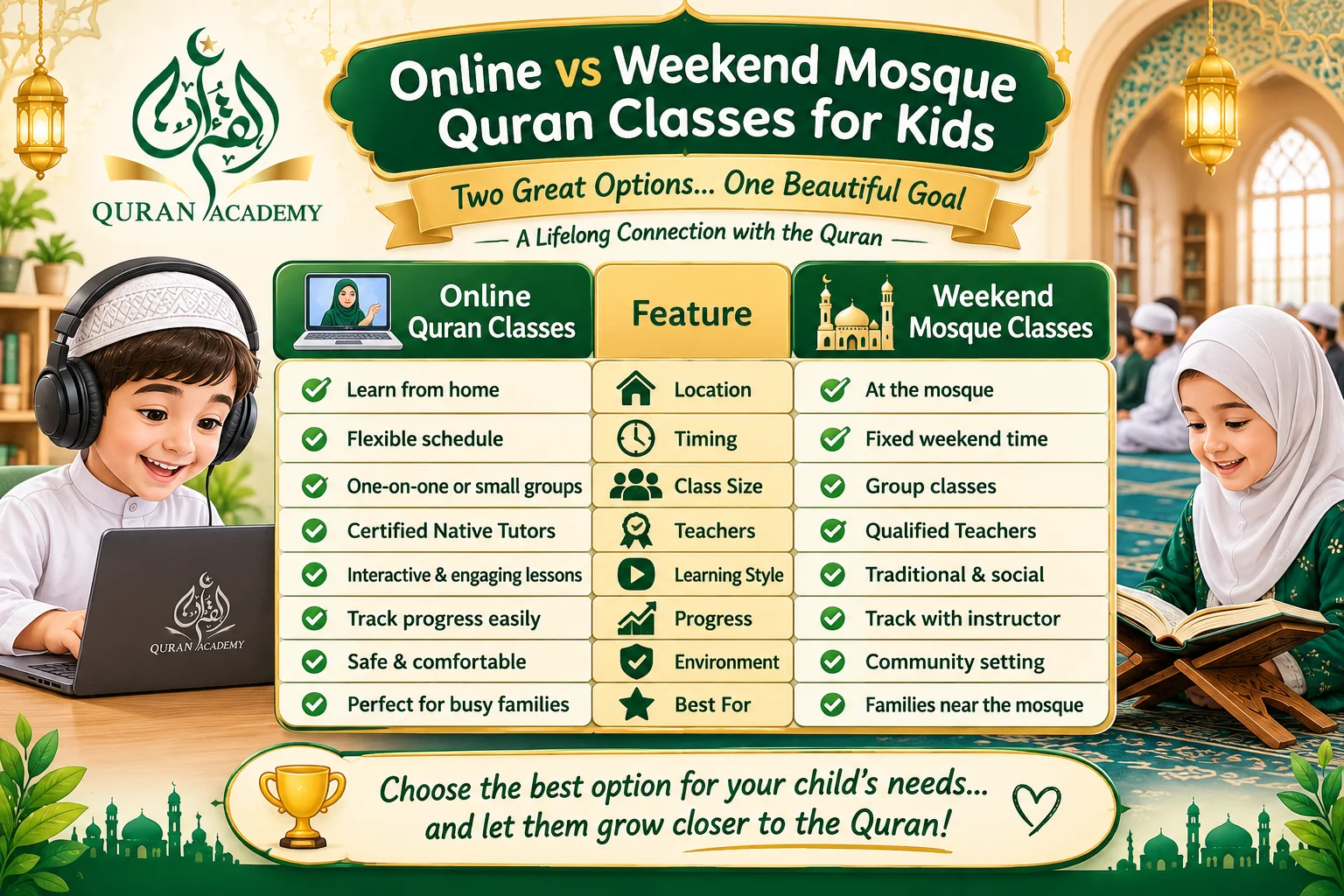
✦ Quick Answer & Key Takeaways: Online vs. Weekend Mosque Classes
When comparing online vs. weekend mosque Quran classes for children, 1-on-1 online Quran classes build reading fluency and Tajweed accuracy 3x to 4x faster, whereas weekend mosque programs excel at peer socialization, group Islamic identity, and congregational prayer habits. In a typical weekend mosque classroom of 15 students, a child receives only 3 to 4 minutes of individual vocal correction per week. By contrast, students in our Fun 1-on-1 Online Quran Classes for Kids receive 90 to 120 minutes of undivided, personalized phonetic coaching every week.
- The "Speaking-Time" Math: Quran recitation is an oral motor skill (Talaqqi). A child who reads aloud for 30 minutes three times a week progresses 900% faster than a child who reads aloud for 4 minutes on Sunday morning.
- The Spaced-Repetition Advantage: Three short weekday sessions (Monday, Wednesday, Friday) prevent the "6-Day Forgetting Gap" that plagues once-a-week Sunday school schedules.
- When Weekend Mosque Classes Shine: Local masjids provide irreplaceable Muslim friendships, Seerah storytelling in groups, and the joy of praying Dhuhr shoulder-to-shoulder with peers.
- The Winning "Hybrid Formula" for Western Families: Use 1-on-1 online classes 2–3 days a week for technical Noorani Qaida, Tajweed, and Hifz mastery, and use the local mosque on weekends for social brotherhood and sisterhood!
Every Sunday morning across New York, Toronto, London, Birmingham, and Sydney, thousands of dedicated Muslim parents wake up early, pack backpacks, and drive through weekend traffic or freezing rain to drop their children off at the local weekend Islamic school. You pay the tuition, volunteer at bake sales, and do it all out of a deep desire to see your child read the Book of Allah fluently.
Yet two or three years later, a painful realization hits many families: while your child has made wonderful Muslim friends and memorized a few short Surahs by ear, they still cannot open an unfamiliar page of the Mushaf and read the connected Arabic script on their own. Why does this happen even in the most well-meaning weekend programs? Let's break down the exact classroom math behind online vs. weekend mosque Quran classes—and how you can give your child both rapid reading fluency and a strong Muslim community without burning out your family schedule.
- The "4-Minute Math Problem": Why Group Classes Struggle With Reading Fluency
- The 6-Day Forgetting Curve: Frequency vs. Marathon Sunday Sessions
- Master Comparison Chart: 1-on-1 Online vs. Weekend Mosque Quran Classes
- What Weekend Mosque Schools Do Best (Why You Shouldn't Abandon the Masjid)
- 5 Ways 1-on-1 Online Coaching Accelerates Noorani Qaida, Tajweed & Hifz
- The "Best-of-Both-Worlds" Hybrid Weekly Schedule for Western Muslim Families
- Frequently Asked Questions (FAQs)
1. The "4-Minute Math Problem": Why Group Classes Struggle With Reading Fluency
Unlike history or Islamic studies—where one teacher can tell the story of the Hijrah to twenty children at once and all twenty children learn simultaneously—Quranic decoding and Tajweed pronunciation cannot be learned passively in a crowd. Learning to pronounce heavy throat letters (Al-Halq), nasal counts (Ghunnah), and vowel elongations (Madd) is a physical motor skill, just like learning to swim or play an instrument.
Look at the simple arithmetic inside a standard 60-minute Quran period at a weekend mosque school with 15 students and 1 teacher:
After attendance and settling down (10 mins), 50 minutes divided by 15 children leaves 3.3 minutes of 1-on-1 teacher listening time per child once a week.
Three 30-minute private sessions per week give your child 90 minutes of active, undivided vocal feedback every week—more in 1 month than a group class gives in 2 years!
In group chanting, shy beginners move their lips without reading the script. In 1-on-1 classes, every single letter your child utters is heard and gently corrected.
This explains the common mystery where a child can chant Surah Al-Ghashiyah along with their Sunday school classmates, yet freezes when asked to read a single line of Noorani Qaida by themselves. Group chanting trains the ear to mimic classmates, whereas 1-on-1 coaching trains the eye and tongue to decode the Mushaf independently.
Why Subtle Pronunciation Errors Slip Past Group Classrooms
In a noisy room of 15 children reciting together, a teacher cannot hear if your child is swallowing the final consonant of a verse. In this 60-second demonstration from our official Quran Academy YouTube Channel, Senior Instructor Ustadhah Yasmeen Gamal shows the acoustic precision that only 1-on-1 audio coaching can catch:
- Hearing the Micro-Bounce: Notice how a muted final ق (Qaaf) or د (Daal) completely disappears unless the teacher listens closely to the student's microphone.
- Instant Muscle-Memory Correction: Catching a pronunciation habit in week one prevents years of unlearning later!
2. The "6-Day Forgetting Curve": Why 3 Short Weekday Sessions Beat 1 Sunday Marathon
In cognitive psychology, Ebbinghaus's Forgetting Curve proves that children forget up to 75% of newly learned phonetic symbols within 48 hours unless those symbols are retrieved and practiced again. As we detail in our parent guide on How Often Kids Should Practice Quran Reading, frequency always beats duration:
Struggling to perfect your Recitation?
Join hundreds of students mastering the Quran with our Verified Al-Azhar Graduates. We offer flexible 1-on-1 sessions tailored to your schedule.
Book a Free Evaluation Class →- The Sunday-to-Sunday Reset Cycle: When a child learns a new lesson on Sunday morning and doesn't see their teacher again for 168 hours (until next Sunday), the first 20 minutes of next week's class are spent re-teaching what was forgotten during the week!
- The 48-Hour Online Momentum Loop: When a child meets their online tutor on Monday, Wednesday, and Friday for 30 minutes, the gap between lessons is never more than 48 hours. Each lesson builds directly on top of warm neural pathways, cutting the total time needed to finish Noorani Qaida from 2 years down to just 4 to 6 months.
The Quran was revealed through direct, one-on-one oral recitation between Angel Jibreel and the Prophet Muhammad (peace be upon him), who then taught his Companions individually and in small circles, saying:
"The best among you are those who learn the Quran and teach it."
3. Master Comparison Chart: 1-on-1 Online vs. Weekend Mosque Quran Classes
To help you make the best decision for your family's schedule and budget, here is an honest, side-by-side comparison across 6 key educational factors:
| Comparison Factor | 1-on-1 Online Quran Classes | Weekend Mosque Classes | Impact on Reading Fluency | Winner for This Factor |
|---|---|---|---|---|
| 1. Active 1-on-1 Speaking Time | 100% of class time (30–45 mins per session, 2–4x a week). | 3 to 5 minutes per Sunday (shared among 12–20 students). | Direct oral feedback is the #1 driver of decoding speed. | 🏆 1-on-1 Online (By 900%) |
| 2. Curriculum Pacing | 100% Custom-Paced: Moves fast when your child masters a rule, slows down when needed. | Fixed Group Syllabus: Fast learners get bored waiting; struggling readers get left behind. | Custom pacing prevents both boredom and anxiety. | 🏆 1-on-1 Online |
| 3. Teacher Qualifications | Ijazah & Al-Azhar Certified native Arab scholars trained in English pedagogy. | Often dedicated community volunteers with varying Tajweed training. | Prevents fossilized pronunciation errors in Makharij & Sifaat. | 🏆 1-on-1 Online |
| 4. Muslim Peer Friendships | Individual tutor-student mentorship (no classmates in 1-on-1 rooms). | High Social Bonding: Kids meet Muslim peers, play at recess, and pray in Jama'ah. | Builds lifelong Islamic identity and love for the masjid. | 🕌 Weekend Mosque |
| 5. Parent Commute & Flexibility | Zero Commute: Study from home in EST/GMT/AEST with 24h rescheduling. | 40–60 mins of weekend driving; missed Sundays cannot be rescheduled. | Zero missed lessons during winter storms, travel, or sports. | 🏆 1-on-1 Online |
| 6. Time to Finish Noorani Qaida | 4 to 6 Months (at 3 classes/week). | 1.5 to 2.5 Years (at 1 group class/week). | Gets kids reading directly from the Uthmani Mushaf 4x sooner. | 🏆 1-on-1 Online |
4. What Weekend Mosque Schools Do Best (Why You Should Never Abandon the Masjid)
Pointing out the mathematical limits of group Quran reading does not mean parents should pull their children out of the local mosque! For Muslim children growing up as a minority in Western countries, the weekend masjid provides three irreplaceable spiritual gifts that no screen can replicate:
- Normalizing Muslim Identity & Peer Belonging: When your child attends public or private secular school from Monday to Friday, they may be the only Muslim in their grade. Walking into the masjid on Sunday morning and seeing fifty other kids wearing Kufis and Hijabs, laughing, and eating pizza together anchors their sense of belonging to the Ummah.
- Experiencing Congregational Prayer (Salah al-Jama'ah): Standing shoulder-to-shoulder in the main prayer hall for Dhuhr prayer, hearing the live Adhan, and watching elders pray teaches physical reverence for Allah's house.
- Group Seerah, Akhlaq & Ramadan Festivities: Subjects like the stories of the Prophets, Islamic history, Eid festivals, and charity drives are much more engaging when discussed in a lively group of peers!
5. Five Ways 1-on-1 Online Coaching Accelerates Noorani Qaida, Tajweed & Hifz
When you shift the heavy lifting of technical Quran reading, Tajweed, and Hifz to our Certified Al-Azhar Tutors during the week, your child's relationship with the Quran transforms in five ways:
- 1. Custom Teacher Matching (Male & Female Specialists): A shy 6-year-old girl can learn with a warm, motherly female Ustadhah, while a 12-year-old boy can study with an energetic male Qari who serves as a role model. (Learn how we vet our faculty in our guide on 7 Essential Criteria for Choosing an Online Quran Teacher).
- 2. Interactive Digital Whiteboards & Visual Phonics: Instead of staring at a distant chalkboard, your child draws on our shared interactive canvas, plays letter-recognition games, and sees color-coded rules from our 1-on-1 Online Tajweed Course zoomed in right on their screen.
- 3. Structured Hifz Using the 3x3 Method: Rather than sending your child home with a vague assignment to "memorize Surah Al-Inshiqaq by next Sunday," our tutors practice the 3x3 Quran Memorization Method live in class so the verses are 80% memorized before the session even ends!
- 4. Instant Parent Progress Dashboards: After every session, your student portal updates with exact percentages for Reading, Tajweed, and Hifz, plus downloadable whiteboard notes and voice-note homework.
- 5. Seamless Path to Official Ijazah: Once your child masters fluent reading, they can transition smoothly into our Online Hifz & Connected Sanad Ijazah Program mapped out with our Smart Hifz Planner.
6. The "Best-of-Both-Worlds" Hybrid Weekly Schedule for Western Muslim Families
You don't have to choose between technical fluency and masjid community! Here is the exact Hybrid Weekly Blueprint used by hundreds of our happiest families (read their stories on our Verified Student & Parent Reviews Page):
- Monday & Wednesday (4:30 PM – 5:00 PM Local Time): 30-Minute 1-on-1 Online Class from home right after school snack. Focus: Technical Noorani Qaida phonics, applied Tajweed, and new 3x3 Hifz lines.
- Tuesday & Thursday (10 Minutes): Independent home review using our 3-Minute Interactive Tajweed Quiz to earn stars on their fridge chart.
- Friday Evening or Sunday Morning (At the Local Mosque): Attend the masjid for Jummah, youth group, Seerah stories, and social playtime with Muslim friends—where your child now shines as one of the most confident Quran reciters in their group!
7. Frequently Asked Questions (FAQs) About Online vs. Weekend Mosque Classes
1. Which is faster for learning to read the Quran: online 1-on-1 classes or weekend mosque classes?
1-on-1 online Quran classes build reading fluency 3x to 4x faster than weekend mosque classes because your child receives 100% of the teacher's listening and correction time across 2 to 3 sessions per week (90 minutes of individual coaching weekly vs. 3 to 4 minutes in a 15-student Sunday classroom).
2. Why can my child recite Surahs from memory at Sunday school but still can't read the Mushaf?
In group weekend classes, children often memorize short Surahs by echoing the chorus of classmates around them without actually looking at or decoding the Arabic letters. Learning to decode unfamiliar words requires 1-on-1 phonetic training (Noorani Qaida) where a tutor tracks your child's eyes and tongue letter by letter.
3. Should I pull my child out of weekend Islamic school if we start online Quran classes?
Not at all! The best approach is a hybrid routine: use 1-on-1 online classes twice a week (30 minutes each) for technical Quran reading, Tajweed, and Hifz mastery, and keep attending your local weekend mosque program for Muslim friendships, Seerah stories, and congregational prayer.
4. Are 30-minute online Quran classes too long for young children ages 4 to 7?
When taught 1-on-1 using interactive whiteboards, digital star stamps, and varied 5-minute activities (phonics, letter games, short Surah echoing, and story time), 30 minutes flies by effortlessly for young learners—without the exhaustion of a 4-hour Sunday school block.
5. How much do 1-on-1 online Quran classes cost compared to weekend mosque tuition?
Despite providing 100% private instruction with Al-Azhar certified scholars, our monthly 1-on-1 plans start at just $32/month ($8/hour) with zero commute gas costs, free digital study materials, and a 100% free evaluation class before you enroll.
Experience What 30 Minutes of Undivided Attention Can Do!
Watch your child read with newfound confidence in their very first session. Book a free, no-obligation 1-on-1 evaluation class with our certified male or female tutors at a time that fits your family's schedule!
Book My Child's Free 1-on-1 Trial Class →